
What Is Local SEO and Why Does It Matter for Small Businesses?
If you run a business that serves customers in a specific city, town, or region, there is a version of Google search working either for you or against you right now. Every day, people in your area are searching for exactly what you offer. Some of them are finding your competitors. Some of them are finding you. Whether you end up in the first group or the second comes down largely to something called local SEO.
Local SEO is not a complicated concept but it is one that a surprising number of small business owners either do not know about, have a vague understanding of, or assume is taken care of simply because their website exists. None of those positions serve you particularly well when a potential customer two kilometres away is searching for a plumber, a dentist, a florist, or a roofing contractor and your business does not appear in the results.
This guide explains what local SEO actually is, how it differs from regular SEO, why it matters so much for small businesses specifically, and what the most important things you can do are to improve your local search visibility starting right now.
What Is Local SEO?
Local SEO is the process of optimising your online presence so that your business appears prominently in search results when people search for products or services in a specific geographic area. It is a subset of search engine optimisation broadly, but it has its own specific signals, tactics, and results formats that differ from general SEO.
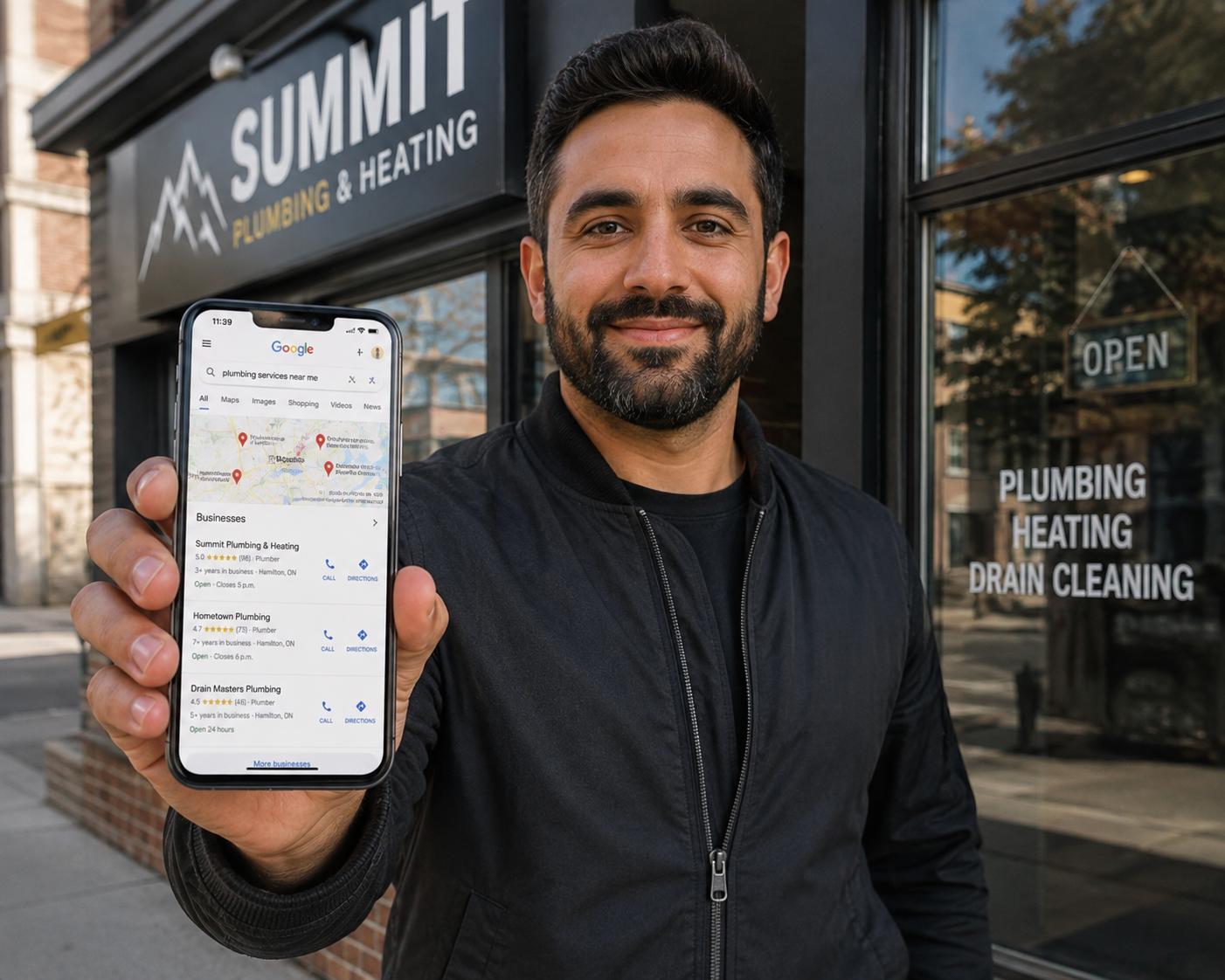
The clearest way to see local SEO in action is to search for something like ‘coffee shop near me’ or ‘plumber in Leeds’ on Google. What you see at the top of the results page, before the organic blue links, is a map with three business listings underneath it. That section is called the local map pack or local three-pack, and it is prime real estate. The businesses appearing there are getting the lion’s share of clicks from people who are ready to buy, book, or call right now.
Below the map pack, the regular organic search results appear. Businesses that rank well in the organic results also benefit, but the map pack sits above them and attracts significantly more attention for local intent searches. Showing up in both is the goal of a comprehensive local SEO strategy.
How Local SEO Differs From Regular SEO
Regular SEO focuses on ranking a website for keywords that do not have a geographic component. A business trying to rank for ‘best project management software’ or ‘how to write a business plan’ is competing on a national or global level and needs to build authority through content, backlinks, and site quality over time.
Local SEO introduces a geographic filter that changes the competitive landscape entirely. Instead of competing with every business in the world for a keyword, you are competing with businesses in your city or service area. That is a dramatically smaller pool. A small plumbing company in Coventry does not need to outrank every plumber in the UK. It just needs to outrank the other plumbers in Coventry. That is an achievable goal for a business of any size if the right foundations are in place.
Local SEO also relies on a different set of ranking signals than regular SEO. While website quality and content still matter, local SEO is heavily influenced by factors like your Google Business Profile, the consistency of your business information across the internet, customer reviews, and proximity to the searcher. Understanding these signals and optimising for them is the core of what local SEO work involves.
Why Local SEO Matters More Than Most Small Business Owners Realise
Your Customers Are Searching Locally Right Now
The volume of local intent searches is enormous and growing. A significant proportion of all Google searches have local intent, meaning the person is looking for something in a specific place or near their current location. Searches containing ‘near me’ have grown dramatically over the past several years and show no sign of slowing. Mobile devices have made this behaviour the default for most consumers: when someone wants something, they search for it on their phone, and Google shows them results relevant to where they are.
For a small business with a physical location or a defined service area, these are exactly the searches you want to show up for. The person searching for ‘electrician near me’ at 9am on a Tuesday is not browsing for entertainment. They have a problem and they need someone to fix it. Being visible at that moment is the difference between getting a call and not getting a call.
Local Search Results Convert at a Higher Rate
Traffic from local search converts at a significantly higher rate than most other traffic sources. When someone finds your business through a local search, they have already established the geographic relevance of your business to their need. They are not casually browsing. They are actively looking for what you offer in a place where you can provide it. That intent is much closer to a buying decision than someone who stumbles across your website through a generic content search.
This is why local SEO delivers a strong return on investment for small businesses even at relatively modest levels of investment. The traffic it generates is highly qualified and the conversion rates from that traffic, calls, bookings, walk-ins, form submissions, reflect the high intent of the people finding you.
Your Competitors Are Already Doing It
In most local markets, the businesses appearing in the map pack and the top organic local results are there because someone has paid attention to local SEO, not because Google randomly chose them. If your competitors are showing up and you are not, local SEO is almost certainly part of why. The good news is that local SEO is not a winner-take-all game where the largest budget wins. A small business with well-optimised local SEO fundamentals can and regularly does outrank larger competitors who have neglected the basics.
The Key Components of Local SEO
Google Business Profile
Your Google Business Profile, previously called Google My Business, is the single most important factor in local SEO for most small businesses. It is the free listing that appears in Google Maps and in the local map pack when someone searches for your type of business in your area. It shows your business name, address, phone number, hours, photos, reviews, and a direct link to your website.
A fully completed, actively managed Google Business Profile dramatically improves your chances of appearing in the map pack. This means filling out every section of the profile completely and accurately, adding high-quality photos of your business, products, and team, posting updates and offers regularly, and most importantly, responding promptly to every review whether positive or negative.
Many small businesses have a Google Business Profile that was created at some point and then largely forgotten. An incomplete profile with outdated hours, no photos, and unanswered reviews is not working for you the way a properly managed one would. Treating your Google Business Profile as an active marketing channel rather than a static directory listing is one of the highest-return local SEO actions available.
NAP Consistency
NAP stands for Name, Address, and Phone number. Google uses the consistency of this information across the internet as a signal of your business’s legitimacy and reliability. When your business name, address, and phone number appear in the same format across your website, your Google Business Profile, directory listings, social media profiles, and any other online presence, it reinforces to Google that your business information is accurate and trustworthy.
Inconsistencies in NAP, a slightly different business name on one directory, an old address that has not been updated, a phone number formatted differently across listings, create confusion for Google and can negatively affect your local rankings. Conducting a NAP audit to identify and correct inconsistencies across your online presence is a foundational local SEO task that is easy to overlook but genuinely matters.
Local Citations
A local citation is any online mention of your business’s name, address, and phone number. Citations appear in business directories like Yelp, Yellow Pages, TripAdvisor, industry-specific directories, and local chamber of commerce websites. The quantity and quality of your citations, particularly from authoritative and locally relevant sources, is a ranking signal that Google uses to assess your business’s prominence and legitimacy in a local market.
Building citations in the right directories for your industry and location is a systematic process that contributes meaningfully to local rankings, particularly for businesses in competitive local markets where the basic optimisation steps have already been taken by most competitors. The key is prioritising quality and relevance over volume, a listing in a respected local business directory or an industry-specific platform is worth more than dozens of listings in low-quality generic directories.
Reviews and Reputation Management
Customer reviews are one of the most powerful local SEO signals and one of the most visible trust factors for potential customers making a decision about which business to contact. The quantity of reviews, the average rating, the recency of reviews, and the pattern of responses from the business owner all factor into local rankings and into the conversion rate of people who see your listing.
A business with forty reviews averaging four point eight stars and recent responses from the owner to both positive and negative reviews will almost always outperform a competitor with five reviews and no responses, all else being equal. Actively encouraging satisfied customers to leave reviews is not gaming the system. It is making sure that your online reputation reflects the actual quality of your service rather than being disproportionately influenced by the rare dissatisfied customer who is more motivated to leave a review than a happy one.
Responding to reviews, including negative ones, is equally important. A thoughtful, professional response to a negative review demonstrates to potential customers that you take feedback seriously and handle problems constructively. Ignoring negative reviews or responding defensively does the opposite.
On-Page Local SEO
Your website needs to signal its geographic relevance to Google as clearly as possible. This means including your city and service area naturally throughout your website content, having a clearly marked contact page with your full address and phone number, embedding a Google Map on your contact page, and if you serve multiple locations, having dedicated pages for each location with unique, relevant content rather than duplicating the same page with just the city name changed.
Creating content that is relevant to your local area also builds geographic signals over time. A roofing contractor writing about hail damage specific to their region, a restaurant publishing content about local events, or a solicitor covering legal topics relevant to their jurisdiction all build local relevance signals that contribute to local rankings alongside the technical optimisation work.
Local Link Building
Links from other websites to your website remain one of the most significant ranking signals in SEO generally, and locally relevant links carry particular weight for local rankings. Sponsoring local events, getting featured in local news outlets, joining your local chamber of commerce, partnering with complementary local businesses, and contributing to local community initiatives are all ways to earn links from locally relevant sources that strengthen your local search authority.
Local link building does not require the scale of a national content marketing program. A handful of genuine, locally relevant links from authoritative local sources can make a meaningful difference to local rankings, particularly in markets where local link building is not yet a standard practice among your competitors.
Common Local SEO Mistakes Small Businesses Make
Understanding what not to do is as useful as knowing what to do. These are the most common local SEO errors that hold small businesses back:
- Leaving the Google Business Profile incomplete or not verifying it, which means it may not appear in map results at all
- Using a PO Box or virtual office address rather than a genuine physical location, which Google’s guidelines prohibit and which can result in listing suspension
- Inconsistent NAP information across online listings that creates confusion about which details are current and accurate
- Ignoring reviews entirely, neither encouraging them nor responding to them, which leaves your reputation unmanaged and signals low engagement to Google
- Targeting only broad keywords without geographic modifiers, missing the local intent searches where the competition is far lower and conversion rates far higher
- Having no location-specific content on the website, making it difficult for Google to establish the geographic relevance of the business
- Treating local SEO as a one-time setup task rather than an ongoing activity, when in reality it requires consistent attention to reviews, profile updates, and content to maintain and improve rankings over time
How Long Does Local SEO Take to Work?
This is the question every business owner asks and the honest answer is that it depends on how competitive your local market is and how much foundational work needs to be done. For businesses in less competitive local markets where the basics have been neglected by competitors, meaningful improvement in local rankings can appear within four to eight weeks of addressing the core fundamentals, particularly the Google Business Profile and NAP consistency.
In more competitive markets or for businesses starting from scratch with no existing online presence, a realistic timeline for strong local rankings is three to six months of consistent work. The important point is that unlike paid advertising where results stop the moment you stop spending, local SEO improvements compound over time. The work you do in month one builds on itself through month six and beyond, and the rankings you earn through good local SEO work continue generating traffic without ongoing ad spend.
How ILANZO Approaches Local SEO for Small Businesses
At ILANZO, local SEO is one of the most common and most impactful services we provide for small businesses across the US, UK, and Canada. Our approach starts with understanding your specific market, your competition, and the current state of your local online presence before recommending anything.
We audit your Google Business Profile, your NAP consistency across directories, your existing reviews and reputation, your website’s local signals, and your current local rankings. From that baseline, we build a prioritised plan that addresses the highest-impact issues first rather than working through a generic checklist that may or may not be relevant to your situation.
We report on what actually matters, local rankings for your target keywords, map pack visibility, calls and direction requests generated from your Google Business Profile, and organic traffic from local searches, not vanity metrics that look impressive but do not connect to revenue.
Final Thoughts
Local SEO is not a technical mystery or a specialist discipline that only large businesses with big marketing budgets can access. It is a set of foundational practices that any small business can implement and that directly determine whether you are visible to local customers who are actively searching for what you offer right now.
The businesses showing up at the top of local search results in your market are not there by accident. They have either worked at their local SEO or had someone work at it for them. The gap between where you are and where you want to be in local search is almost always bridgeable with the right attention and the right approach.
If you want to understand exactly where your local SEO stands and what it would take to improve it, book a free strategy call with the ILANZO team. We will look at your specific market, your current visibility, and your competition and give you a clear picture of the opportunity. Visit ilanzo.digital to get started.
Recent Posts

September 10, 2026
Why Your Google Ads Are Not Converting (and How to Fix It)


Related Articles
Google Ads vs Meta Ads: Which One Is Right for Your Small Business?
Warning: Undefined variable $taxonomy in /home/ilanzo/public_html/wp-content/themes/bw-digiflow/bzotech-templates/posts/grid/grid-style2.php on line 50

How to Find Affordable Digital Marketing Solutions to Boost Your Website Traffic
Warning: Undefined variable $taxonomy in /home/ilanzo/public_html/wp-content/themes/bw-digiflow/bzotech-templates/posts/grid/grid-style2.php on line 50

SEO vs Google Ads: Which Should a Small Business Do First?
Warning: Undefined variable $taxonomy in /home/ilanzo/public_html/wp-content/themes/bw-digiflow/bzotech-templates/posts/grid/grid-style2.php on line 50


Leave a comment