
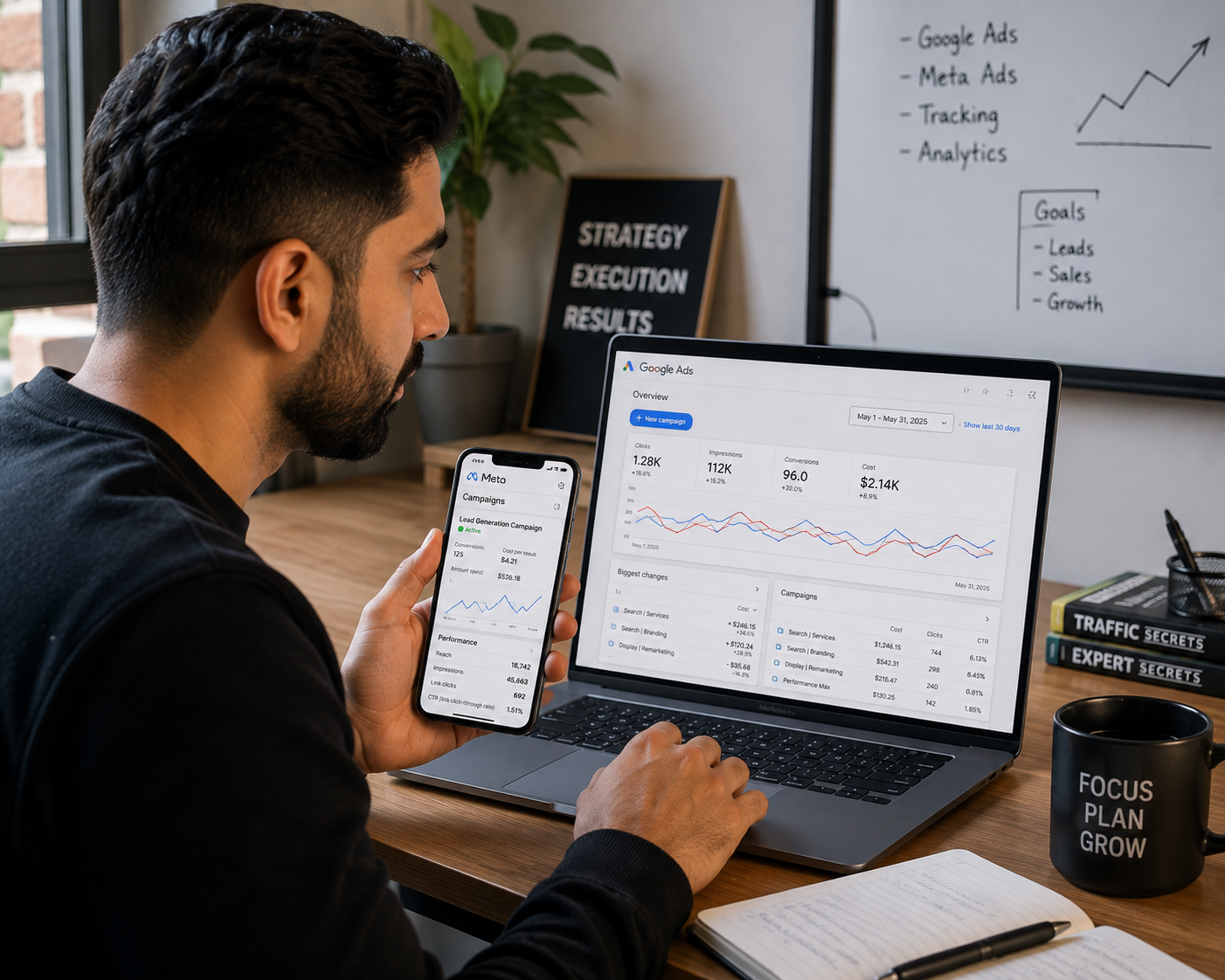
Google Ads vs Meta Ads: Which One Is Right for Your Small Business?
If you have a budget for paid advertising and you are trying to figure out where to spend it, Google Ads and Meta Ads are almost certainly the two options on your shortlist. Both are the dominant platforms in their respective spaces. Both can drive meaningful traffic and leads for small businesses. And both are platforms where a small business with a modest budget can genuinely compete if the campaigns are set up correctly.
But they are not interchangeable. They work on fundamentally different principles, they reach people in fundamentally different mindsets, and they perform significantly better for some business types than others. Choosing the wrong platform, or splitting a limited budget between both without a clear strategy for either, is one of the most common and most expensive mistakes small businesses make with paid advertising.
This guide gives you a straight, practical comparison of how Google Ads and Meta Ads work, which businesses tend to see better results from each, and how to think through the decision for your specific situation without wasting budget finding out the hard way.
The Fundamental Difference: Intent vs Interruption
The single most important thing to understand about Google Ads versus Meta Ads is the difference in the mindset of the person seeing your ad.
Google Ads is an intent-based platform. When someone sees your ad on Google, it is because they typed something into a search box. They have a specific need or question in mind and they are actively looking for an answer or a solution. An emergency plumber who shows up at the top of Google search results for ’emergency plumber available now’ is reaching someone who needs a plumber right now. That person is primed to act. The ad is not interrupting anything. It is answering the question they just asked.
Meta Ads, which covers both Facebook and Instagram, is an interruption-based platform. People on Facebook and Instagram are not searching for anything. They are scrolling through a feed of content from friends, family, pages they follow, and now ads that Meta’s algorithm has decided to show them based on their demographic profile, interests, and behaviour. Your ad appears in that feed and has to earn attention from someone who was not looking for you and may not have any immediate need for what you offer.
This distinction drives almost every other difference between the two platforms and is the primary reason one works significantly better than the other for different business types and objectives.
How Google Ads Works
Google Ads operates primarily through a keyword auction system. You select the keywords you want your ads to show for, set a maximum bid for each click, write ads that appear in the search results when those keywords are searched, and pay only when someone clicks your ad. The position of your ad in the results is determined by a combination of your bid and your Quality Score, which reflects the relevance of your keyword, ad, and landing page to the search query.
The most powerful aspect of Google Ads is the directness of the connection between what a person is searching for and what you are offering. A roofing company bidding on ‘roof replacement quote Edmonton’ is reaching someone who is actively in the market for exactly that service. The conversion path from search to click to inquiry is short because the person’s intent is already established before they see the ad.
Google Ads also includes display advertising through the Google Display Network, YouTube advertising, and Google Shopping for e-commerce businesses, but for most small businesses the core of the platform is search advertising, and that is where the intent-based advantage is strongest.
How Meta Ads Works
Meta Ads operates through an audience targeting system rather than a keyword system. Instead of selecting keywords, you define who you want to reach based on demographics such as age, gender, and location, interests and behaviours that Meta has inferred from user activity across its platforms, or custom audiences built from your own customer data or website visitors. Meta’s algorithm then serves your ads to people within those audiences as they scroll through their Facebook or Instagram feeds.
The creative format of Meta ads is fundamentally different from Google search ads. Because you are interrupting someone’s browsing rather than answering a query, the visual quality and immediate impact of your ad matters enormously. Static images, video ads, carousel formats showing multiple products or features, and story ads that fill the full screen are all available formats. The ad that stops someone mid-scroll and makes them pay attention is doing the hardest part of the job.
Meta’s targeting capabilities are genuinely powerful. The ability to target people based on specific interests, life events, job titles, income brackets, purchase behaviour, and hundreds of other data points means you can reach a very specific slice of the population with a very specific message. This precision is most valuable when you are trying to reach people who fit a specific profile rather than people who are searching for a specific thing.
Head to Head: Google Ads vs Meta Ads
| Google Ads | Meta Ads | |
| Intent | High — user is actively searching for what you offer | Low to medium — user is browsing, not searching |
| Targeting | Keyword-based — you target what people search for | Demographic and interest-based — you target who people are |
| Ad format | Text ads in search results, shopping, display | Image, video, carousel, stories across Facebook and Instagram |
| Best for | Service businesses, high-intent products, local leads | Brand awareness, visual products, impulse purchases, remarketing |
| Average CPC | Higher — especially in competitive industries | Generally lower — but conversion rates can be lower too |
| Speed to results | Fast — ads show immediately for your keywords | Fast — but may need more time to find the right audience |
| Creative demand | Low — strong headline and copy is enough | High — visuals and video drive performance significantly |
When Google Ads Is the Better Choice
Google Ads consistently outperforms Meta Ads for businesses where the customer journey starts with an active search. If your potential customers know they have a problem and are searching for someone to solve it, you want to be visible at that moment of intent. Here is the profile of a business where Google Ads is typically the right starting point:
Service Businesses With Immediate Needs
Plumbers, electricians, roofers, locksmiths, dentists, solicitors, accountants, and similar service businesses sell solutions to problems that people actively search for when the need arises. Nobody browses Instagram hoping to find a plumber. When a pipe bursts or a tooth aches, they go to Google. Google Ads puts your business in front of these high-intent searchers at exactly the right moment. The conversion rates from Google search ads for these businesses tend to be significantly higher than from Meta Ads because the audience is already motivated.
Local Businesses With a Defined Service Area
Google Ads allows precise geographic targeting combined with location-based keywords that are particularly effective for local service businesses. A heating and cooling company targeting ‘furnace repair near me’ in a specific city is reaching people in that city with an immediate need. The combination of geographic and keyword targeting on Google produces highly qualified local leads that are difficult to match with Meta’s interest-based approach.
Businesses Selling High-Consideration Products or Services
When the purchase decision involves significant research, comparison shopping, and deliberation, the person researching is actively searching. Legal services, financial products, home renovation services, industrial equipment, and similar high-consideration purchases all involve a search phase where Google Ads can capture people in active buying mode. Meta Ads can play a role in these funnels as a remarketing tool to re-engage people who have already shown interest, but the initial capture tends to happen on Google.
When Meta Ads Is the Better Choice
Meta Ads performs best when the goal is to reach a specific type of person rather than capture people searching for a specific thing, or when the product or service is visual, lifestyle-oriented, or benefits from social proof and discovery. Here is when Meta typically wins:
Visual or Lifestyle Products
Fashion, home decor, beauty products, food and beverage, fitness, travel, and similar categories benefit enormously from Meta’s visual ad formats and the browsing mindset of its users. A beautifully shot image of a product or a short video showing it in use can create desire and drive purchases from people who had no prior intention of buying that product. This discovery dynamic is where Meta’s interruption model becomes a genuine advantage rather than a limitation.
Building Brand Awareness in a Defined Demographic
If your goal is to make a specific demographic aware of your brand over time rather than capturing immediate intent, Meta’s demographic and interest targeting is far more powerful than Google’s keyword approach. A new business that wants to establish brand recognition among a specific age group, income bracket, or interest community can reach that audience repeatedly with brand-building content at a lower cost per impression than most other channels.
E-commerce With a Broad Product Range
E-commerce businesses with a wide range of products benefit from Meta’s ability to show dynamic product ads to people based on their browsing behaviour, including people who have visited your website, viewed specific products, or abandoned a cart. Meta’s retargeting capabilities are particularly strong for e-commerce, and the visual product formats on Instagram and Facebook are well-suited to showcasing products in an engaging way.
Lower Average Order Values Where CPC Economics Matter
In industries where the average transaction value is modest, Google’s typically higher CPC can make the unit economics of Google Ads difficult to justify. A business where a customer is worth twenty to thirty dollars cannot afford a ten to fifteen dollar cost per click in a competitive Google auction. Meta’s generally lower CPCs, combined with strong audience targeting, can make the economics work for lower-margin businesses where Google search advertising is simply too expensive relative to the value of a conversion.
The Case for Using Both
The Google Ads vs Meta Ads question is sometimes not either/or. For businesses with adequate budget and clear objectives for each platform, using both together can produce results that neither achieves alone. A common and effective approach is to use Google Ads to capture high-intent search traffic and Meta Ads to remarket to people who visited the website from Google but did not convert on the first visit.
This combination works because the person who searched on Google and visited your website is a warm audience. They have already shown intent. Showing them a Meta ad after they leave, whether a reminder of what they looked at, a special offer, or a testimonial from a satisfied customer, keeps your business visible and often prompts the conversion that the initial visit did not produce. The remarketing audience from Google traffic is typically one of the highest-converting audiences available on Meta.
The budget required to run both platforms meaningfully is higher than either alone, and the management complexity increases. For businesses with limited budgets, choosing the right primary platform and executing it well is more effective than splitting a modest budget between both.
How to Make the Decision for Your Business
Rather than defaulting to one platform based on what competitors seem to be doing or what the last article you read recommended, work through these questions to reach a decision grounded in your specific situation:
- Do your potential customers know they have a problem and actively search for a solution, or do they need to be made aware that your product or service exists? If they search, start with Google. If they need to discover you, start with Meta.
- Is your product or service visual? Does seeing it create desire or understanding that reading about it does not? If yes, Meta’s image and video formats are an advantage. If your service sells on specifics and benefits rather than aesthetics, Google search copy can do the job without strong creative.
- What is a customer worth to your business? If the lifetime value is high and you can afford a meaningful cost per acquisition, Google’s higher CPCs are easier to justify. If margins are tight and customer value is modest, Meta’s lower entry costs may be more workable.
- How quickly do you need results? Both platforms can generate traffic quickly, but Google search ads typically produce more immediate, predictable results for service businesses because the intent is established. Meta often requires more testing and optimisation time before consistently strong results emerge.
- What is your budget? If you have under five hundred dollars per month, concentrate it entirely on one platform. Split budgets at that level produce insufficient data and insufficient volume on either platform to optimise effectively.
How Ilanzo Approaches This Decision With Clients
At Ilanzo, we manage Google Ads and Meta Ads campaigns for small businesses across the US, UK, and Canada. When a new client comes to us asking which platform is right for them, we do not have a default answer we push everyone toward. We look at their business type, their customer journey, their budget, and their objectives, and we give them an honest recommendation based on where their budget is most likely to generate a meaningful return.
For most local service businesses we work with, Google Ads is the starting point because the intent-based traffic it produces converts at a higher rate and the path from ad to inquiry is shorter. For e-commerce clients and businesses with strong visual products or brand-building goals, Meta is often the better primary channel or a strong complement to search.
What we do not do is run both platforms simultaneously for clients with limited budgets just to diversify. Concentration beats diversification at small budget levels. We run the right platform well rather than running two platforms adequately.
Final Thoughts
Google Ads and Meta Ads are both legitimate, proven advertising platforms that work well for small businesses when matched to the right objectives and executed properly. The decision between them comes down to one fundamental question: are your customers searching for what you offer, or do they need to discover it? Answer that honestly and the right platform for your situation becomes much clearer.
If you want a straight opinion on which platform makes more sense for your specific business and how to get the most from your advertising budget, book a free strategy call with the ILANZO team. We will look at your situation and give you a clear recommendation without the sales pitch for whichever service is most profitable for us. Visit ilanzo.digital to get started.
Recent Posts


June 19, 2026
How Much Should a Small Business Website Actually Cost?
Related Articles
What Is Local SEO and Why Does It Matter for Small Businesses?
Warning: Undefined variable $taxonomy in /home/ilanzo/public_html/wp-content/themes/bw-digiflow/bzotech-templates/posts/grid/grid-style2.php on line 50
How to Find Affordable Digital Marketing Solutions to Boost Your Website Traffic
Warning: Undefined variable $taxonomy in /home/ilanzo/public_html/wp-content/themes/bw-digiflow/bzotech-templates/posts/grid/grid-style2.php on line 50

How Much Should a Small Business Spend on Google Ads? A Realistic Budget Guide
Warning: Undefined variable $taxonomy in /home/ilanzo/public_html/wp-content/themes/bw-digiflow/bzotech-templates/posts/grid/grid-style2.php on line 50

Leave a comment